Beyond the Ballroom: Putting Structured Serendipity at the Center of the Annual Meeting
Photo: Cre8con, CC BY-SA 2.0, via Wikimedia Commons
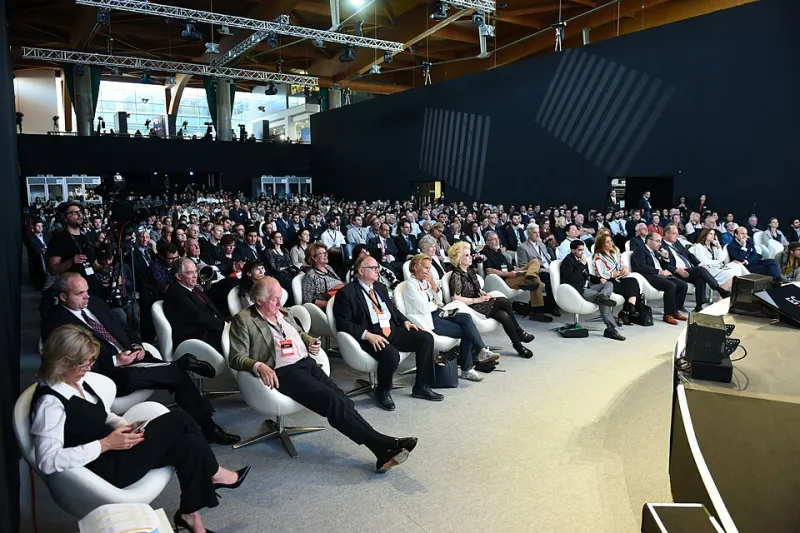
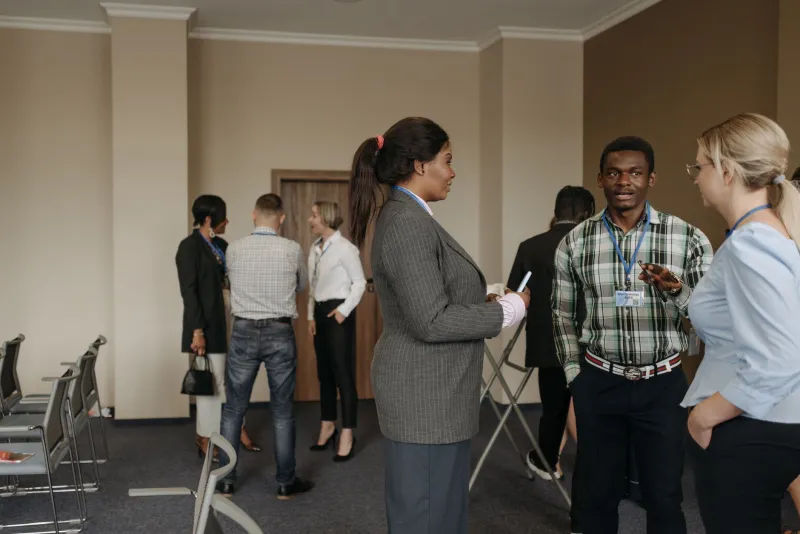
Every conference organizer has seen the same photograph: a session room half full, a corridor outside packed shoulder to shoulder. The presenter is competent, the slides are current, and the audience is thirty feet away, standing near a coffee urn, solving a problem that no session on the agenda addressed.
It would be easy to read that scene as a failure of member discipline. It is better read as a specification. Members are telling their associations, in the clearest way available, what they came for and what they will pay for again next year.
The session is not the product
Formal education still matters, particularly where licensure, safety, or technical standards are involved. But it increasingly competes with material that is free, current, and available on demand. A practitioner who can watch a recorded webinar from her desk on Tuesday is not going to sacrifice a Thursday afternoon in a strange city for a similar presentation unless something about being in the room changes the outcome.
What changes the outcome is other people. Attendees come for the peer who solved their procurement problem last quarter, the supplier engineer who can explain a warranty dispute, the competitor who will say candidly what a new regulation actually does. Those exchanges are not a break from the program. In practical terms, they are the program.
What the badge scans do not tell you
Registration systems record attendance. They do not record value. A member who skips four sessions, holds five conversations in the exhibit hall, and returns to work with a vendor contact and a peer benchmark has had a better meeting than one who sat through six presentations and spoke to no one.
Post-event survey language reflects this consistently. When asked what was most valuable, respondents cite conversations, hallway introductions, and informal problem-solving far more often than individual sessions. Yet budgets, room blocks, and speaker contracts are still built almost entirely around the formal track, and the networking that members prize is left to emerge by accident, usually in the margins between scheduled content.
Four design moves for 2026
1. Schedule the corridor. If informal exchange is the main event, give it a time slot and a room. Structured networking blocks of 45 to 60 minutes, placed deliberately after content-heavy sessions rather than at the end of a long day, convert accidental conversations into reliable ones. Provide prompts: a question on each table tent, a named convener, a stated topic.
2. Build a first-timer path. The member most likely to leave without a single meaningful conversation is the one attending alone for the first time. A short orientation, a hosted table at the opening reception, and a paired introduction to two members with similar practice areas cost almost nothing and change the entire trajectory of the experience.
3. Use topic tables instead of open seating. Open seating reproduces the conference's existing social structure, which is a polite way of saying that the people who already know each other sit together. Assigned topic tables — one on workforce shortages, one on permitting, one on equipment lifecycle costs — give strangers a legitimate opening line and give the association a read on which issues are live in the field.
4. Add a scheduled unconference block. Set aside a half day with no pre-set speakers. Attendees propose topics on the morning of, vote with their feet, and reconvene in small groups with a facilitator and a one-page capture form. The format is not new, but it is underused in trade settings precisely because it cannot be fully scripted in advance. That is the point.
The sponsor question
Suppliers fund a large share of most annual meetings, and they will want time on the floor. Give it to them in a form that serves members rather than interrupting them. Scheduled solution sessions, defined appointment blocks, and technical clinics where a manufacturer's engineers answer questions without a sales script all produce better engagement than a rotating roster of sponsored keynotes that attendees skip.
Transparency remains essential. Members accept commercial participation when it is labeled and bounded. They react poorly when the boundary between education and pitch is ambiguous, and they express that reaction by not returning.
Measuring a meeting you did not script
You cannot evaluate unstructured time with the same instrument you use for sessions. Consider a short set of measures, collected through the badge system, a brief exit survey, and staff observation.
- Session-to-networking ratio — the share of programmed hours devoted to each; a useful starting point is roughly one hour of structured exchange for every two hours of formal content.
- First-timer return rate — whether those attending for the first time come back the following year.
- Contact density — the self-reported number of new professional contacts made, captured at exit.
- Issue capture — the number of distinct field problems surfaced at topic tables and unconference sessions, which doubles as a content pipeline for the following year.
- Sponsor satisfaction — measured against qualified conversations, not impressions or badge scans.
A closing argument
An annual meeting is the one moment when a dispersed industry occupies the same building. That is an expensive and increasingly rare condition, and it deserves to be designed around the exchange it makes possible rather than around the sessions that could have been delivered online.
Treat the hallway as the main stage, staff it, schedule it, and measure it. Members will notice the difference before the survey results arrive, and they will describe it the way associations most want to be described: as the place where the industry actually talks to itself.